Design that converts: aesthetics as persuasion.
Every visual decision you make on your site directly impacts how much the user trusts you. It's not design for design's sake — it's strategy.

Why design sells
94% of first impressions of a digital product are design-related. Not functionality, not price, not reviews — how it looks. That's power, and most companies waste it.
At Synttek every visual decision — from type hierarchy to section spacing — carries a business hypothesis behind it. Aesthetics are the silent argument that convinces before the user reads a single word.
“Aesthetics aren't decoration — they're the first argument you make to your user.”
The first 50 milliseconds
A Carleton University study found that users form a visual impression in just 50 milliseconds — 20 times faster than a blink. In that time, they read nothing.
They perceive palette, density, type weight and hierarchy. If that perception doesn't build instant trust, everything that follows is wasted marketing.
Typography that speaks
Typography does 80% of the visual work. The choice of family, weight, tracking and leading communicates personality before the reader processes meaning. It's not a detail — it's your brand's voice.
Using a single type family forces you to build hierarchy with scale and weight, not family contrast. The result is more coherent, more technical, more memorable.
Why we avoid mixing families
Every new type family you add is one more decision the user has to process without noticing. Geist Sans does all the work — display, body and labels — with a single set of rules.
Color as a strategic decision
At Synttek we use a single accent: lime #A1E233. Not because we like green — a single accent applied with discipline builds more memorability than three colors applied at random.
Restriction isn't a limitation — it's the tool. When the user sees lime in your interface, they know it matters. It's the only color asking for attention; that's why it works.
You might also like
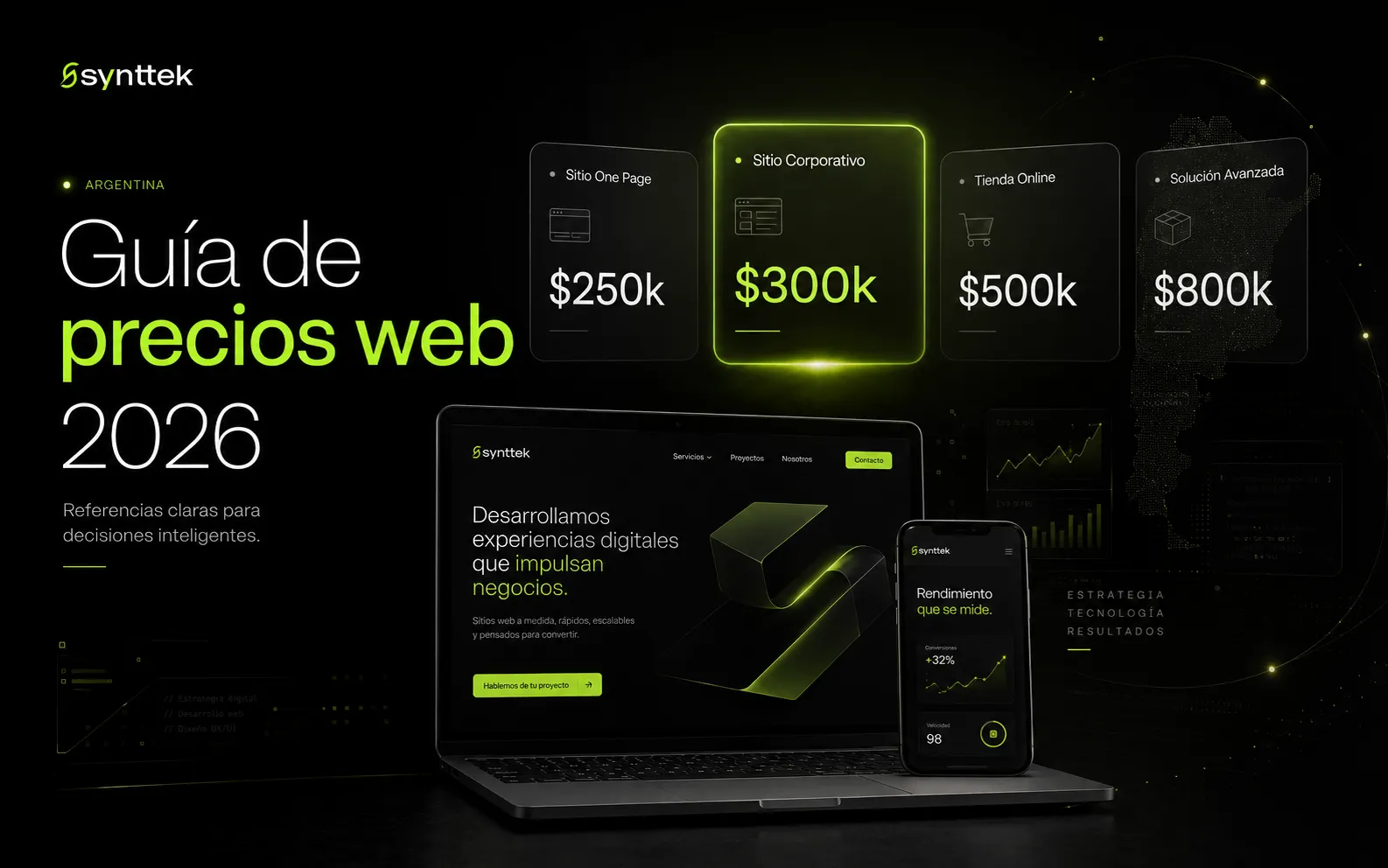
How much does a website cost in Argentina in 2026
A clear guide to understand how much a professional website can cost in Argentina, what each type of project includes, and how to choose the right option for your business.

We don't build decorative websites. We build digital assets.
A pretty site that moves no one is an expense. How we treat every project as an investment with measurable return.